Finance closed the month by hand
Invoices, expenses and payroll arrived from different places, so the monthly close depended on one person reconciling exports rather than on the system.
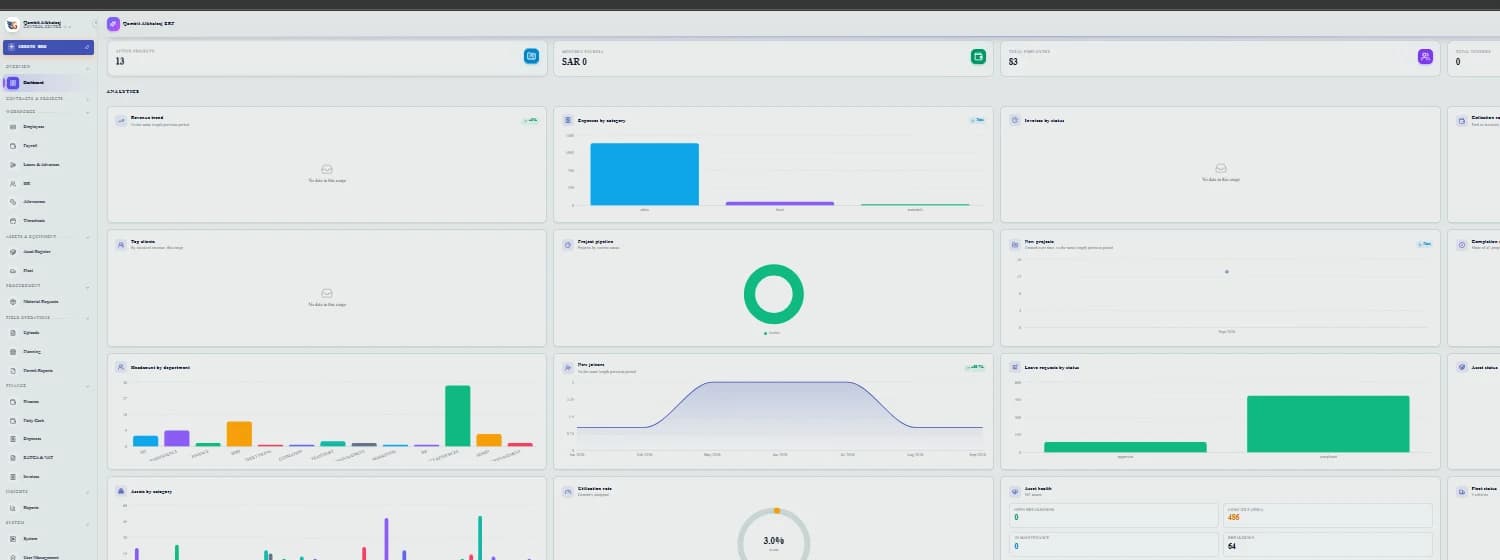
Gambit Gulf runs horizontal drilling, micro-tunneling and pipeline crossings across the Eastern Province. Their finance, HR, fleet and project data lived in separate systems and a long chain of spreadsheets. We replaced all of it with a single platform their whole company works in.
The situation
Like most contractors of their size, the company had grown faster than its systems. Each department solved its own problem, and the gaps between them were being filled by hand — which is manageable at ten projects and impossible at fifty.
Invoices, expenses and payroll arrived from different places, so the monthly close depended on one person reconciling exports rather than on the system.
Assets, breakdowns, maintenance and assignment lived in separate sheets, so nobody could say what a machine had cost or when it was last serviced without asking three people.
Attendance came in from sites on sheets, leave was approved in messages, and every allowance and deduction was applied manually before the WPS file could be produced.
ZATCA e-invoicing, GOSI, iqama and certificate expiry were each tracked outside the systems that created the underlying records.
Built module by module and released in stages, so the company kept working while each area moved across.
Chart of accounts, journal entries, cost centres, receivables and payables, bank accounts and reconciliation, petty cash, and VAT returns produced from the ledger itself.
Invoices generated, stamped and archived inside the same flow that records the work, with a dedicated VAT ledger and its own ZATCA configuration per entity.
Employees, contracts, attendance, timesheets, leave requests, loans and advances, allowances, recruitment and sponsorship transfers — feeding payroll runs and expiry alerts for iqama and certificates.
Tenders, quotations, estimation, contracts, project planning, permit reports, crossings and job completion, with client statements of account drawn from the same records.
Asset register and categories, equipment assignment, breakdowns, workshop jobs, preventive maintenance schedules and checklists, and TÜV certificate tracking.
Material requests, purchase orders, supplier invoices and stock, connected to the projects and cost centres the spend belongs to.
What changed
The change is structural rather than cosmetic: the same transaction now updates finance, stock and the project it belongs to, and compliance is produced by the system instead of assembled alongside it.
Modules replacing separate tools and sheets
Database tables behind one shared record
Source of truth for every department
Chosen for a system this size to stay maintainable for years, and to be handed over without lock-in.
That is exactly where this project started. Tell us where your numbers stop matching and we will show you what one platform would look like.